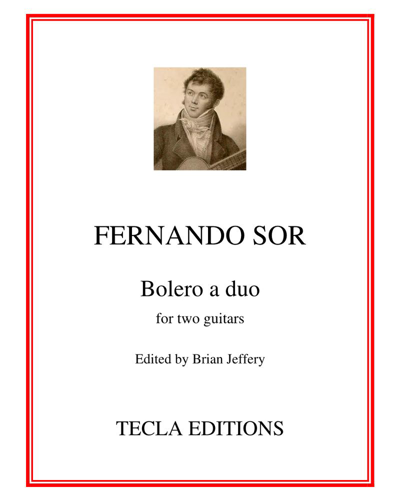
Bolero a duo
For Two Guitars
- Composer
- Fernando Sor
- Publisher
- Tecla Editions
- Ensemble
- 4 Guitars
- Pages / parts
- 7 pp. · 5 parts
- Catalog No.
- TECLA X 10145
- Purchase orders
- cdiyao@gmail.com (Email to Purchase)
For Two Guitars
This page provides catalog information. File access follows customer service and copyright requirements.
Although this Bolero a duo survives only with parts for two guitars and
nothing else and it has been published as a guitar duet, I wish to suggest that
in fact it may not be simply a guitar duet but rather an accompaniment, for
two guitars, to a bolero for two voices by Sor. I shall explain below why I
believe that this may be so. If this hypothesis is correct, then it is historically
significant because it gives us the only known authentic accompaniment for
two guitars to any of Sor’s songs, and also musically interesting because it
works extremely well as an accompaniment for a bolero. Also, because it has
such character, and because it can easily hold its own against the voices, it
can provide a model for performers of other songs by Sor who may wish to
try their hand at improvising accompaniments in the style of the time. 1 must
emphasize, however, that at this time it is only a hypothesis, and the piece
may of course be played as a guitar duet by anyone who wishes to do so.
The Bolero a Duo is found in only one known source, an edition printed in
Madrid between 1817 and 1824 entitled Colección selecta de música
ynstrumental para guitarra sola de los mejores autores nacionales y
estrangeros. In that source it is entitled Bolero a Duo con dos guitarras
compuesto por D. Fernando Sor. It is a short but lively piece as befits a
bolero, full of zest and colour. It breathes the rhythmic vitality of other
known pieces related to Spanish dance at this time such as Aguado’s
fandango for guitar, Soler’s fandango for keyboard, Boccherini’s fandango,
or indeed the other boleros of Sor for voice(s) and guitar or piano.
There are, however, some questions about what exactly it is. Is it an original
work by Sor? Or perhaps an arrangement from something else? Is it for two
guitars and nothing else, or is it an accompaniment to a song? And if it is by
Sor, then what date is it? We do not have many firm answers, but there are
some clues.
The source
Only one copy of the Colección is known, now in the Biblioteca Nacional in
Madrid, who kindly provided me with photocopies and whom I thank for
permission to reproduce the original in facsimile here, at the end of this
present volume. The reproduction of the original here may be particularly
valuable to scholars in this case because of certain editorial conundrums
which presented themselves in the course of establishing the text. (Another
copy was in the collection of Domingo Prat, who referred to it in his
Diccionario de Guitarristas (Buenos Aires, 1934), p. 302. The present
whereabouts of that copy is unknown.)
When I visited the Biblioteca Nacional de España in about 1973, working on
my biography of Sor, the library was unfortunately not able at that time to
make their copy of the Colección available to readers, so that this piece
could not be included in my earlier edition of Sor’s Complete Works for
Guitar. And indeed, at that time it would not have been easy to explore any
association with Sor’s boleros, because practically none of them had at that
time been published (my edition of Sor’s Seguidillas dates from 1976, and
More Seguidillas from 1999). A modern edition of the Bolero a Duo was
published in Madrid, as a duet for two guitars, in 1994 (Bolero a Duo, edited
by Javier Suárez-Pajares (Madrid, Opera Tres, 1994). In this 1994 edition
the “Fin” and “D.C.” indications were removed and repeats added to the
second half. While these changes are quite defensible for a performance (see
above), the editorial notes of the 1994 edition did not say what changes had
been made from the original, so that it was not possible to know from the
1994 edition what the original form was, and the absence of a complete
facsimile made it impossible to see for oneself.
The Colección may be dated by bibliographical means. Its title-page gives
the address “en el despacho de la calle del Turco”, an address which was
used by the engraver and music publisher Bartolomé Wirmbs between 1817
and 1824 (cf. C.J. Gosálvez Lara, La Edición Musical Española hasta 1936
(Madrid, 1995), p. 192).
The Biblioteca Nacional copy consists of three numbers;
No. 1 (shelf-mark Mp 4203/9) containing Sor’s Andante sentimental y walz
para guitarra [= op. 5 nos. 5 (the well-known “Andante largo”) and 6] (the
opus
numbers given here are for reference only and do not appear in the
Colección);
No. 2 (shelf-mark Mp 4203/8) containing Sor’s La Siciliana, sonata para
guitarra [= op. 2 no. 6], Minuet [= op. 5 no. 3], Minuet [= op. 5 no. 1], and
Wals [= op. 5 no. 2]; and
No. 3 (shelf-mark Mp 4203/10) containing this Bolero a Duo con dos
guitarras compuesto por D. Fernando Sor and a minuet by Roldan.
The wording of the title suggests that the Colección was intended to be part
of a series containing music by various composers, but only these three parts
are known.
The source of the source
Where did the compiler of the Colección get the music? The answer is likely
to be different for the Bolero a Duo than for the solos. All the solos could
have been taken from copies of editions published in London or Paris which
had found their way to Madrid, because opus 5 had been published in Paris
in 1814, and opus 2 had been published in London at some time between
1813 and 1819 and in Paris between 1816 and 1822 (see my book Fernando
Sor, Composer and Guitarist, second edition, Tecla, 1994, Catalogue).
But the Bolero a Duo is of a completely different nature from those pieces
and as such does not lie within the same publishing tradition. Musically, it is
not in the central European post-Haydn tradition like those other works but
rather in the pure idiom of its native Spain. No edition published outside
Spain is known for it, and there is little probability that it comes from such
an edition which is now lost. Almost certainly its source is not an edition
from outside Spain, but rather a native source, which would most probably
have been a manuscript rather than a printed edition.
When the Bolero a Duo was published in Madrid between 1817 and 1824,
Sor was not there but in London. Javier Suarez-Pajares, the editor of the
1994 edition, suggested that the manuscript of the Bolero a Duo may have
been entrusted by Sor at that time to his friend Francesco Vaccari to bring
from London to Madrid—indeed, at one point of his introduction Mr.
Suarez-Pajares appears to present his theory as fact (page 2 of the
introduction, although it is probably because of faulty translation in its
English version, since it does not appear in the same way in the Spanish).
However, I think that that theory is unlikely. One would have to imagine that
Sor, living in London at that time prolifically composing such things as
ballet music, Italian arietts, and guitar music in a new style, would have
selected or newly composed a piece in the old Spanish style which for him
by then lay in his distant past, that he would then have sent it to Madrid for
publication, and that after so much care had been taken, that it would then
have been published there in the kind of omnium gatherum of miscellaneous
pieces which is what the Colección really is. One would also have to
suppose that Sor, only too aware of his political exile, and given the
opportunity to have some music of his published in Spain, would have
chosen to send this scrap of a piece rather than one with more stature. Nor is
it likely that he would have allowed the Bolero a Duo to be published in its
present quasi-improvisatory form if he or even a friend of his had had any
control over the publication. There would be no parallel to it anywhere else
in his works: his other works are usually tidy, thoroughly correct and
finished, not improvisatory. I think it is unlikely that this piece as we have it
today is a finished work by Sor which he knowingly allowed to be published
in the form in which we have it: rather, I think it likely that the publisher in
Spain took it from a manuscript which was already in Spain, from the time
when Sor was living and composing in that country.
The form of the piece
The piece is entitled “Bolero”. To what extent is it in fact a bolero? How far
does it fit the bolero form, and if at all, then what kind of bolero in
particular?
As is known, the bolero came into existence in Spain in the late eighteenth
century, quickly caught on and became very popular by about 1800, and
later in altered form swept through Europe. One of the most important
accounts of its history is given to us by Sor himself in his article “Le Bolero”
(this article by Sor is published in full in my edition of his Seguidillas). In
that article Sor gives us three examples of boleros, one instrumental and two
sung, and of course he also composed many other examples of the genre for
which he is today justly celebrated.
Our Bolero a Duo has a first section ending with the word “Fin” and then a
second section ending with “D.C.”, that is to say, you play again from the
beginning as far as the word “Fin”. The “Fin” and “D.C.” are clearly printed
in both parts. That does not fall obviously into the classic bolero form as
seen, for example, in the songs in the Seguidillas, nor into the variants of it
which we find in the examples given in “Le Bolero” such as “Yo no se lo
que tiene” which has a different form. If we were to assume that the “Fin”
and the “D,C.” were mistakes and remove them, and if we were to add repeat
marks to the second section, which is what Javier Suárez-Pajares did in his
edition, we would then be closer to the standard bolero form, but the piece
would still be a loose expression rather than a precise example of it. Also,
the problem with doing that is that not all boleros of the time, by any means,
followed precisely the same form. There were many different possible
structures, not just one standard one. It is therefore possible that the original
indications of this piece may give us a valuable insight into ways in which
boleros in general, and this one in particular, might have been performed at
the time. This present edition therefore keeps the original form, but anyone
who in performance wishes to remove the “Fine” and the “D.C. al Fine” and
repeat the second section is at liberty to do so and will then be closer to the
form of the bolero of the time as it is found in, for example, Sor’s
seguidillas.
The group of three notes in bar 12 is typical of the beginning of the second
part of a bolero.
Is it a guitar duet? If it is, then no other of its kind is known. We have no
other guitar duets from Sor’s pen before L’Encouragement of 1828—not a
single one of any kind. Nor do we have any instrumental pieces in the
Spanish style by him from an early date. Nor do we have any instrumental
works by him in such an improvisatory style—not a single one, at any date,
in any instrumentation whatsoever. Yes, they could have existed but all been
lost, but the fact remains that at the present time we have no evidence of any.
There does exist one guitar duet by Sor in the Spanish style, namely the
“Allegro dans le genre espagnol” in his Fantaisie for two guitars op. 54 bis,
which dates from about 1833 and is not a bolero but rather a fiery movement
in dance style reminiscent of Aguado’s Fandango. But whereas the Bolero a
Duo has every sign of coming straight from a living native tradition of
dance, the Fantaisie was written many years later in a foreign land.
The Bolero a Duo as an accompaniment to a bolero for two voices?
Merely as a hypothesis, I would suggest that this Bolero a Duo may be in
fact an accompaniment for two guitars to a bolero by Sor for two voices. The
clue lies in the precise wording of the original title. It says: Bolero a Duo
con dos guitarras compuesto por D. Fernando Sor, that is to say a bolero a
duo, not para dos guitarras, but con dos guitarras: not for two guitars, but
with them. The word “con” springs to the eye as soon as you realise that the
two solo guitar works by Sor in this Colección which have the name of the
instrument are both introduced by the word “para”: “La Siciliana, sonata
para guitarra”, and “Andante sentimental y walz para guitarra”. The Bolero a
Duo uses a different word, “con”. The reason could well be that the Bolero a
Duo was a piece which was to be performed not by two guitars but with
them, in other words something else was once there but is now missing.
Armed with that idea, the obvious place to look for further evidence is—
where else?—Sor‘s boleros. I have now published two books of these, his
Seguidillas (1976) and More Seguidillas (1999). A close examination of all
the songs has not revealed any exact correspondence. But there is one song
where the parallels with the Bolero a Duo are close: “Sin duda que tus ojos”,
a particularly beautiful song for three voices in the More Seguidillas. Here
are the parallels.
“Sin duda que tus ojos” has a chromatic passage at the point where the
words describe the poison that lies in the beloved’s eyes; it is found at bars
5-7 and 21-23. The Bolero a Duo also has just such a chromatic passage, at
bars 8 and 20.
“Sin duda que tus ojos” has a striking modulation at bars 12-13—and the
Bolero a Duo has a similar modulation at the same place.
“Sin duda que tus ojos” has a series of grace notes, a kind of breathlessness
of the lover, at bar 14—and so has the Bolero a Duo at the same place.
When you consider that none of these three features is common in Sor’s
seguidillas, then the fact that they are all found in “Sin duda que tus ojos”
and also in the Bolero a Duo does suggest a parallel. What could it be? I
believe a further clue again lies in the very title: Bolero a Duo con dos
guitarras: that is to say, translated exactly: a bolero for two voices or two
people, with two guitars. Not a bolero a duo because it is for two guitars, but
more probably bolero a duo because it is for two voices, in this case
accompanied by two guitars. The omission of the voice parts is a
phenomenon of notation which will be only too familiar to anyone who has
studied such early sources as, for example, the ancient Spanish vihuela
books.
If this hypothesis is correct, then the bolero in question was a bolero for two
voices. The compiler of the Colección will have taken the two guitar parts
from a manuscript or manuscripts containing them and which may also have
contained the two voice parts. I don’t think he misunderstood them and
thought they were a guitar duet, because if he had, he would have been more
likely to have headed the music with a title such as “Bolero para dos
guitarras”, or at any rate with some title which included the word “para”
(“para dos guitarras”) and not “con”. Rather, I think he was publishing what
he knew to be an accompaniment, and a particularly fine one, something
which brings life to a song, and we should be grateful to him for having
done so because it casts a great deal of light on how we can now go about
performing Sor’s boleros with much more insight than was previously
possible. And just as a guess, I think that what we may be looking at is an
accompaniment for a bolero for two voices, either for a two-voice version,
for which as yet no source is known, of “Sin duda que tus ojos”, or else for
some other song, as yet unidentified, of similar character and structure.
Moreover, I don’t think it likely that the accompaniment in the form in
which we have it was composed by Sor; rather, it may be one or two
generations away from the original, perhaps even an arrangement by
someone unknown from an accompaniment for solo guitar or piano which he
had heard Sor or someone else play, or which he had seen in a manuscript.
From a performer’s point of view it is extremely interesting, because until
now the guitar accompaniments in More Seguidillas are not strong enough to
provide a balanced accompaniment to the voices, but this Bolero a Duo is
because it provides two guitars playing at the same time, to balance the three
voices of the song.
A possible performance of “Sin duda que tus ojos” with the Bolero a
Duo as an accompaniment
Working on the hypothesis which I have suggested, there are two ways in
which one might today perform “Sin duda que tus ojos” with the Bolero a
Duo as an accompaniment. One is to take the existing three-voice “Sin duda
que tus ojos” and adapt the Bolero a Duo to it, and the other is first to adapt
the existing three-voice version of “Sin duda que tus ojos” to make a
hypothetical version of it for two voices, and then to adapt the Bolero a Duo
to it. In either case the vocal parts would need to be transposed from D to A.
Either of these could be done reasonably easily, and I eagerly await the time
when a performer will carry it out, and when we may be able to place the
reconstruction on this website. Or perhaps one day another bolero by Sor for
two voices may be found, to which the Bolero a Duo does fit exactly.
This edition
In editing this piece, I have silently corrected obvious errors and added rests,
etc., where necessary. I have not considered it necessary to give chapter and
verse for these editorial details because anyone who is interested in them can
easily consult the original which is reproduced here. Here, however, are a
few notes.
Bar 3, guitar 1, etc.: slurs added on the analogy of bars 1 -2.
Bar 11, guitar 1, slurs are editorial, on the analogy of bar 16.
Bar 14, guitar 1, should the Bs in the second and third beats in the bar be flat
or natural? In the original no natural is given to cancel the flat on the B of
the first beat, and so one would assume that all the Bs in this bar are flat. Mr.
Suárez-Pajares in his edition has added a natural to the Bs in the second and
third beats in the bar, no doubt by analogy with bar 7. However, bar 7 is
quite a different situation. Here in bar 14 I prefer to respect the notation of
the original (also it fits better with “Sin duda que tus ojos”, if this were to be
considered as in any way an accompaniment to that song).
An examination of the notation of the Bolero a Duo in its original edition
shows that it has the character of a performer’s aide-mémoire. In it, legibility
is a priority but exactness of notation is not. For example, at bar 16 in the
guitar 1 part the three notes in the bass are obviously three quavers (eighth
notes) but in the original are written without tails, which makes them appear
as though they were crotchets (quarter notes), and also the scribe or engraver
has not bothered to insert the necessary rest at the beginning of the bar.
Performers’ note for the Bolero a Duo: if preferred, the “Fine” and “D.C. al
Fine” can be removed and the second part of the piece can be repeated (see
above for discussion of this).
This edition comes from the new 2019 second edition of Sor’s New Complete
Works for Guitar edited by Brian Jeffery. The Introduction and Index to the
entire series are here in nkoda.
This new edition is copyright © by Brian Jeffery 2019. Your cooperation is
requested in not making illegal copies for other people.
Brian Jeffery
Dmitri Shostakovich
Dmitri Shostakovich
Dmitri Shostakovich
Dmitri Shostakovich
Dmitri Shostakovich
Dmitri Shostakovich